Wartime beginnings
Raymond Kennedy

“Holland and Britain are parasite states. Need colonies to live. We don’t. We can afford to be generous.”1
Raymond Kennedy of Yale set that down during the war, in a set of telegraphic notes headed “The Colonial Problem and the Future.” They come from a folder of memoranda he wrote for the State Department which employed him alongside the OSS to analyse the European empires in Asia. The we is American and runs through the whole folder. The Dutch and British, in these pages, “never educated many natives. We did”; they stalled on self-government while America kept its promises; and, in case the generosity should read as sentiment, “I base my stand not entirely on humanitarianism, but on practical considerations.”2
Kennedy had first come to the Indies at the end of the 1920s not as a scholar but as a car salesman, three years selling American cars in Java before the slump sent him back to Yale for a doctorate. It was in fact the war that turned the knowledge to account. Washington wanted men who could read a region the country would have to fight across and then administer, and assembled them out of OSS desks, State Department memoranda and officer-training schools. Yale’s 1947 Council on Southeast Asian Studies, its first area-studies program, was built from what that effort left behind, the trained analysts and the language courses. Kennedy was the analyst it formed around, the author of Islands and Peoples of the Indies (1943) and, for a while, more or less the whole of the field.
You may remember, from the last two posts, that both auditors of the December 1949 conference reached for Kennedy last and held him least firmly. Ettinghausen could manage only: “It may be assumed that the anthropologist, Dr. Raymond Kennedy of Yale University, who is now in Sumatra, may also have a marginal interest in Islamic studies pertaining to Southeast Asia.” The man the surveys could only gesture at had spent the war analysing the region for Washington. I had promised a third conference paper next; the third name took me instead to his own boxes.
The same folder holds a memorandum from 1942, “Acculturation and Administration in Indonesia,” and it has the architecture the first post was circling. Kennedy lays Indonesia out in strata: “The native peoples of the East Indies have passed through three successive periods of alien domination,” Hindu first, then, six hundred years ago, the spread of Mohammedanism “over most of the Indies,” then the Dutch.
3 Islam enters not as a subject in its own right but as the middle of three deposits, the placement the conference papers gave it too, a layer inside someone else’s frame rather than a field of its own.
His account of the Dutch folds back into the second post, and sits oddly beside his own notes. The man who said the Dutch educated no one writes here that they made a serious scholarship and governed with a light hand, drawing the sultans and radjas into the administration so that, as he puts it, the officials “have ruled through them.”4 Schiller, in 1949, admired the Leiden adat scholars for having “delved deeply” into Indonesian customary law; Kennedy, seven years earlier, reaches the same admiration more plainly: “I believe I can state unreservedly,” he writes, “that the Dutch have been the foremost scholars of primitive law in the world.” The two judgments do not reconcile, and there is no reason they should. A man who believed society could be studied like physics will have believed its future calculable too.
That belief carries the paper to its close. Kennedy has before him a “preliminary sketch” of “equal partnership in a dual state,” almost certainly the restructuring Queen Wilhelmina had promised by radio in December 1942. He takes it at face value, calls it “the revolution in Dutch policy toward the Indies,” and predicts “a strong, self-reliant Indonesia, no longer an antiquated, profit-making reservation, but an oriental bastion of democracy.”5
In 1949 he left New Haven for a fifteen-month research trip across Southeast Asia, the trip Ettinghausen referred to in my first post. On 27 April 1950, on the road from Bandung toward Cheribon, near Tomo in West Java, the jeep carrying Kennedy and the Time-Life correspondent Robert Doyle was stopped by an armed band and both men were shot. The independence he had sketched in 1942 had come instead through occupation and a savage on-and-off war. The killers were never identified.6
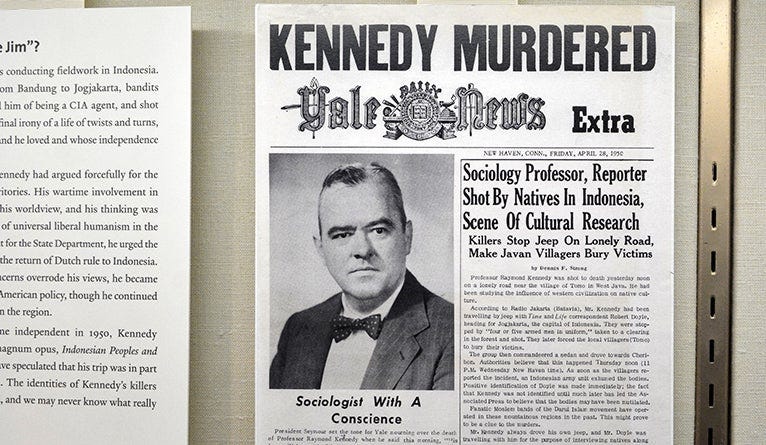
The front page of the Yale Daily News on April 28 1950 announcing the murder of Professor Raymond Kennedy. Source: Yale Daily News
The obituary in The Far Eastern Quarterly was written by John Embree, whose conference papers furnished the first two posts. Eight months after Kennedy, in December 1950, Embree died in a car accident in Hamden, outside New Haven, and the tribute he had written for his colleague appeared that February, after he too was gone.
More Kennedy in two days: it’s a two-post week.
Raymond Kennedy, “The Colonial Problem and the Future,” n.d., Raymond Kennedy Papers, MS 1046, Box 1, Folder 1, Manuscripts and Archives, Sterling Memorial Library, Yale University.
Richard Ettinghausen, “Islamic Studies on Southern Asia,” paper prepared for the Conference on Southern Asia Studies, December 2–4, 1949, p. 2, John Fee Embree Papers, MS 976, Box 3, Folder 19.
Kennedy, “Acculturation and Administration in Indonesia,” [1942], p. 1, Raymond Kennedy Papers, MS 1046, Box 1, Folder 1.
Kennedy, “Acculturation and Administration in Indonesia,” p. 4.
Kennedy, “Acculturation and Administration in Indonesia,” p. 12.
John F. Embree, “Raymond Kennedy, 1906–1950,” The Far Eastern Quarterly 10, no. 2 (February 1951): 170–72.