Post-War Field Formation: Southeast Asia

“Islamic studies in Southern Asia have so far found no proper place in American research. Only Mughal miniatures and Adat Law have been treated with somewhat more interest, but the resources in the United States, including original material, have not yet been exhausted. In all cases people who have dealt with Islamic studies had but a marginal if not an ephemeral interest in it. So far there seems little chance that this situation can be remedied, because the scholarly personnel and institutional interest are lacking.”1
These are the closing lines of a two-page paper written by Richard Ettinghausen of the Freer Gallery of Art, for the ACLS-SSRC Joint Committee on Southern Asia’s Conference on Southern Asia Studies, held December 2-4, 1949. Welcome to Debris. This week I’m in Sterling Library at Yale, reading the conference’s data papers, and Ettinghausen’s is the one I keep returning to. There is something striking, even a little bracing, about a senior scholar at a major museum surveying his neighbouring field and concluding, in his closing paragraph, that there is little chance the situation will be remedied. The paragraph has the flatness of a curator filling in an inventory form, the kind of flatness that turns out, on later reading, to be substantially right.
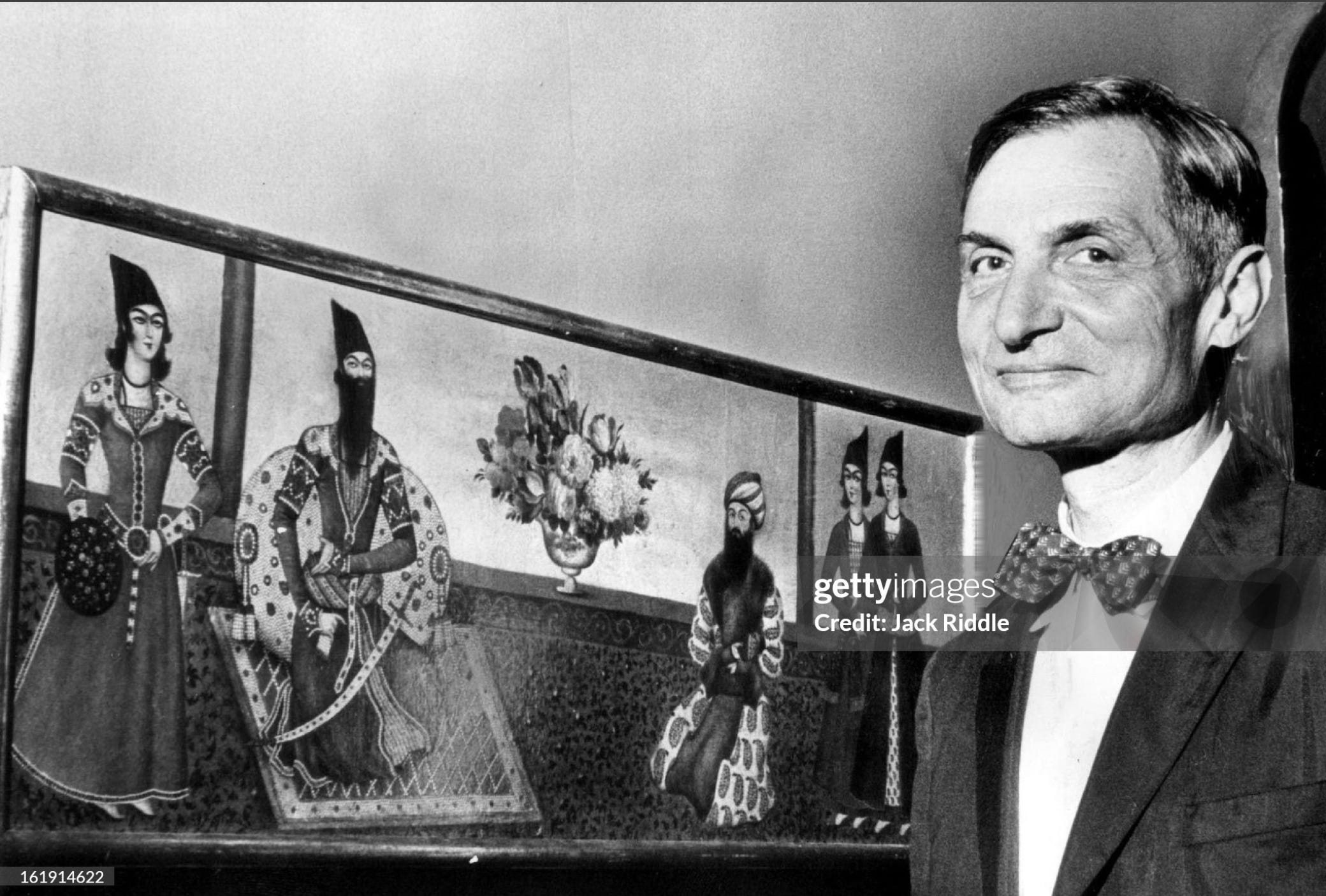
Richard Ettinghausen, August 1964 before lecturing on Iranian art (Source: Getty Images)
The paper is structured as a series of small audits, and that is precisely what makes it useful for those of us looking back at the field in the years immediately after the Second World War. Ettinghausen is not arguing a thesis; he is counting things, libraries and scholars and books and articles and courses, and the counting produces a clearer picture of the post-war American academic infrastructure for the study of Islamic South and Southeast Asia than any retrospective account I have read, because the counting was done at the time by someone who knew everyone in the field and could name them, or, in many cases, could note their absence by name.
Afghanistan first. “There are no specialists of this branch of Islamic Studies in the United States.” A few articles by Richard Frye at Harvard, some material in Florence Day’s care at the Metropolitan Museum, the anthropological work of Hudson and Bacon on the Hazara which Ettinghausen describes, in a quietly deflating phrase, as “of marginal interest for Islamic studies.” Then India and Pakistan, where Ettinghausen finds a respectable list of library holdings (Widener, Yale, the Ames Library at St Paul, Hartford Seminary, the Hoover at Stanford) but, in the way of personnel, only one person who has written extensively on the intellectual and political movements of Indian Islam. That person is Wilfred Cantwell Smith, who would go on to become one of the major figures in twentieth-century Islamic studies. He founded the Institute of Islamic Studies at McGill in 1951, directed the Center for the Study of World Religions at Harvard from 1964, and wrote The Meaning and End of Religion (1962), still one of the most influential books on the comparative study of religion in the English language. In December 1949 he was thirty-three years old, intermittently in the United States, and Ettinghausen had to note, in a slightly awkward sentence, that the only person he could name was not really American. Smith was Canadian, trained at Toronto, had published his Modern Islam in India: A Social Analysis during the war in 1943.2
For Southeast Asia, the inventory becomes shorter. “No library seems to have made special efforts to collect Islamic material for the other areas of Southern Asia.” Then the personnel paragraph in full:
“Professors Arthur Schiller of the School of Law, Columbia University, and E. Adamson Hoebel of New York University, made special studies of the Adat or Customary Law of the East Indies; this research is only a ‘sideline’ in the larger frame-work of their legal studies. It may be assumed that the anthropologist, Dr. Raymond Kennedy of Yale University, who is now in Sumatra, may also have a marginal interest in Islamic studies pertaining to Southeast Asia.”3
The Islamic content of Southeast Asian law is, in 1949, classified by the two scholars who study it as a side-interest in their main projects. Hoebel was a legal anthropologist whose primary work was on Native American law; he had written, in 1941, the foundational The Cheyenne Way with Karl Llewellyn. Schiller on the other hand, was a scholar of Roman law at Columbia Law School, whose comparative interests extended to African customary law. Their adat work fitted alongside, as one comparative case among several. The third figure named in this small inventory, Raymond Kennedy, gets only a “may also,” which I find moving in a way I can’t quite explain. Ettinghausen is reaching, in the third name, for someone he hopes might count, while signalling that he isn’t sure.
Reading Ettinghausen’s paper alongside the others in the folder makes the diagnosis sharper. There is an excellent paper in the same conference packet by A. Arthur Schiller, two pages on Law in South Asia, which begins by mapping the legal landscape of the region in one long, dense, beautifully economical paragraph (seven legal traditions across eight political units, in barely more than a hundred words) and then concludes that “this appears to be the extent of American effort devoted directly to the law of South Asia, so far as a fairly comprehensive bibliographical search reveals.” The extent, in Schiller’s accounting, is Schiller. I’ll come back to Schiller next week, in his own right, because he deserves a post of his own.
What is striking about reading these papers side by side is how their inventories converge. The legal scholars Schiller names as the only American writers on Southeast Asian law are exactly the legal scholars Ettinghausen names as the only American writers on Southeast Asian Islam, which is to say that the American academic infrastructure for both fields, in 1949, consisted of a single desk at Columbia Law and a sideline interest at NYU, with both scholars holding their primary commitments elsewhere. Islam, in this map, is not a sub-field of Islamic studies. It is a sub-field of comparative customary law, which is itself a sub-field of jurisprudence. The Islamic content enters the American academic frame as one component of adat, the customary practice, treated within a framework whose centre of gravity lies elsewhere entirely.
Ettinghausen’s two pages are the cleanest single statement I have found of what was missing from the American academic study of Islamic Southeast Asia in the mid-twentieth century, and why. The diagnosis is structural. The infrastructure was thin, and what work existed was being done inside other fields, by scholars whose main reference points lay elsewhere. The Islamic content of the region was studied through frameworks that had been built for other purposes, and the frameworks shaped what was studyable. This is the framing within which I have done much of my own work on Arab merchant networks in colonial Southeast Asian courts.4
The turn, then. Ettinghausen could see, with great clarity, that Islamic Southeast Asia had a place in American scholarship but not its own place. It existed inside other fields as an aside, never as the figure.
Today’s post has been two pages from December 1949, by a curator at the Freer, naming an issue the field would carry for a long time. Thursday I’ll write about Schiller’s paper, which is even shorter than Ettinghausen’s and which makes the same diagnosis from inside the legal academy.
Richard Ettinghausen, "Islamic Studies on Southern Asia," paper prepared for the Conference on Southern Asia Studies, December 2-4, 1949, p. 2, John Fee Embree Papers, MS 976, Box 3, Folder 20, Manuscripts and Archives, Sterling Memorial Library, Yale University.
Wilfred Cantwell Smith, Modern Islām in India: A Social Analysis (London: Victor Gollancz, 1946).
Ettinghausen, "Islamic Studies on Southern Asia," p. 2.
Nurfadzilah Yahaya, Fluid Jurisdictions: Colonial Law and Arabs in Southeast Asia (Ithaca: Cornell University Press, 2020).